About
I build the thing, not just brief it.
I'm a product and AI delivery person with five years across B2B enterprise SaaS, B2C mobile and e-commerce. I sit between the people who decide what to build and the people who build it. Most of my career has been spent finding that the gap between them is where products quietly fail.
That means the work is rarely just design. It's the business case that gets the thing funded, the constraint nobody checked, the compliance review before launch, the tooling that removes a bottleneck. I care about the version that actually ships.
I hold dual New Zealand and South Korean citizenship, and I work across English, Korean and Japanese, which has meant carrying the same argument through three languages and into rooms with very different expectations.
How the work moved
Design roles on the spine, the work hanging off them. The shift from product design into AI delivery is easier to see as a line than to claim in a sentence.
- 2026NZ Investment TrackerPersonalDirected AI research agents, verified every load bearing claim, then designed and shipped the build.
- Code to Figma with MCPPersonalGenerated a 17-component Figma library out of a codebase nobody had ever drawn.
- DKXFreelanceFigma to production on my own, with Claude Code, no handoff document.
- JourneyPalPersonalFirst application built with AI coding tools, across Codex, Gemini and Claude Code.
- Stress testing a roadmap decisionPersonalClaude Code subagents that argue with my decisions before I build.
- 2025Product SpecialistElsevierPure, an AWS hosted research platform. Introducing AI responsibly into software people are protective of.
- Pure: where the data livesElsevierFound the hosting answers support did not have, and checked them against Korean data handling policy before rollout.
- Pure: from tickets to outreachElsevierRead a month of tickets together and turned the patterns into an outreach campaign.
- 2024Product Manager, contractDigitalogThree months owning the AI strategy for an integrated marketing platform in Seoul.
- ConmaDigitalogChose the platform's first two AI features, deliberately unglamorous ones. Both shipped.
- 2023Product Designer, Product ManagerZOZO NZ3D body scanning, iOS subscriptions, and the confidential AI concepts for the Japanese parent company.
- AI diagnostics proof of conceptZOZOLed the concept and business case to investment approval at the Japanese HQ. Confidential, opens with a passcode.
- Design System Audit PluginZOZOWrote it solo on the OpenAI API. Ran for a week; the per-file cost is why it stopped.
- ZOZOFIT × Apple HealthZOZOFITThe KPI said engagement. The reviews said causation. I built for causation.
- ZOZOFITZOZOFITMultiple B2C launches, and the paywall review that happens before App Review does it for you.
- Bada TVFreelance1,419 survey responses that reordered a roadmap built on guesses.
- 2022Senior Product DesignerNomos OneLease accounting SaaS, where a misplaced field costs an accountant an afternoon.
- 2021Experience DesignerCatch DesignAgency work across energy, broadband and national loyalty programmes.
- AA SmartfuelCatch DesignTook the call centre out of a password reset.
- MercuryCatch DesignDiscovery on a broadband purchase journey that meant reading a table.
- GolfixxFreelanceAn identity that had to survive a building, a scorecard and a browser tab.
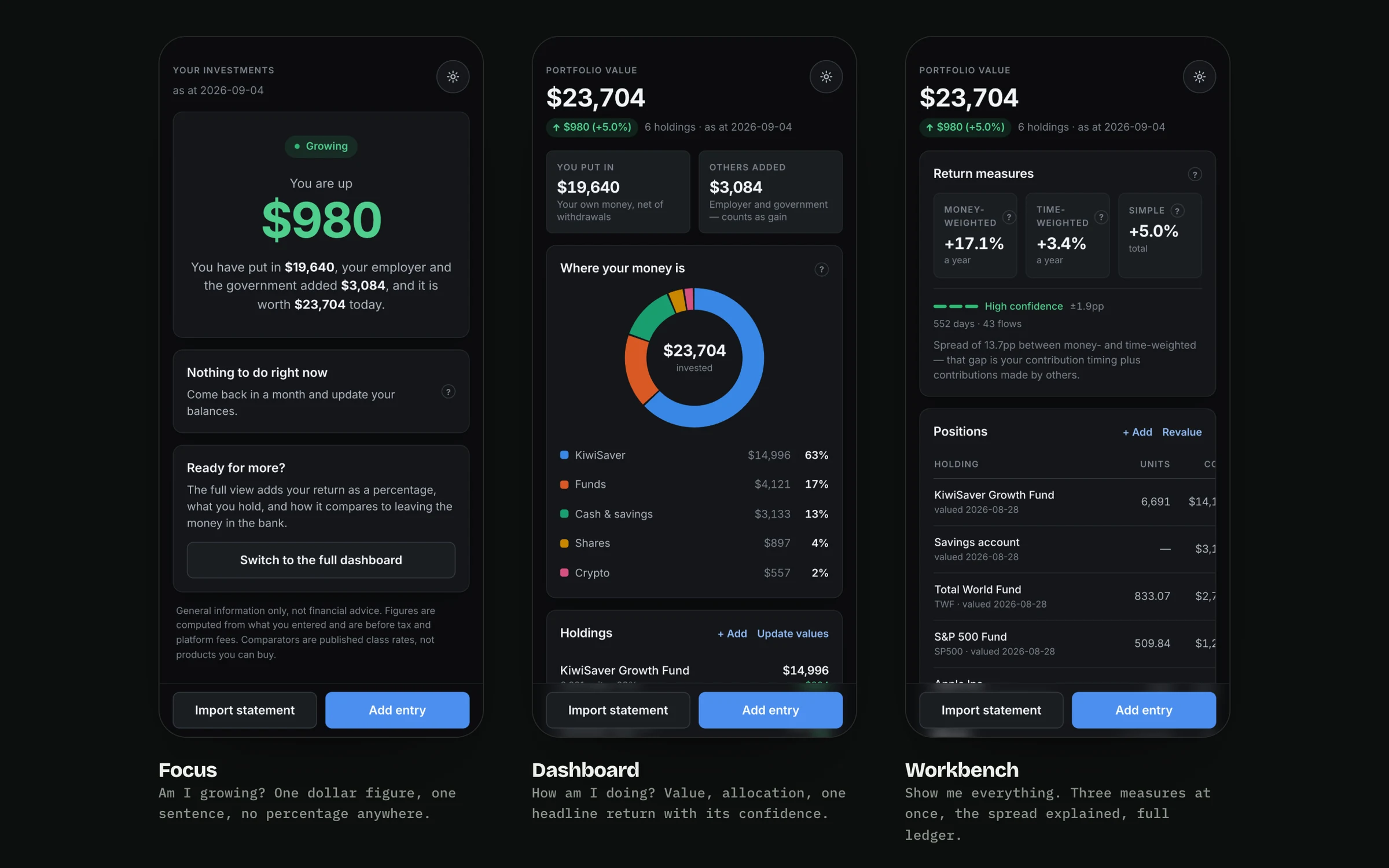
NZ Investment Tracker · 2026
Point at a project to see it. Every row opens its case study.
Positioning
- 01
Product Design
Interaction Design at AUT, then agency work at Mercury and AA Smartfuel. Learning how an established design system works from the inside, and how to add to one without breaking it.
- 02
Product Thinking
Nomos One and ZOZO. Dense, compliance heavy workflows where the interface is the least of the problem and the constraint nobody checked is the whole of it.
- 03
Product Management
Owning delivery across multiple B2C launches, then taking a proof of concept to investment approval in front of a CTO. Learning that the business case is a design problem with its own audience.
- 04
AI Product
Claude and OpenAI integrations, an internal plugin a design team adopted, responsible AI work inside an enterprise platform, and products I now research, define and build myself.
Why the foundation matters
Design gave me things that are hard to pick up later: user empathy that survives contact with a roadmap, systems thinking, the ability to prototype an idea instead of describing it, and enough craft to make a decision land when I present it.
Product management added the rest: strategy, discovery, prioritisation, working across functions, and enough technical understanding to know which constraints are real and which are habit.
Together they mean I can take an ambiguous problem, frame it, decide what should exist, and build enough of it to find out whether I was right.
Experience
- 2025 to 2026Remote
Product Specialist · Elsevier
Pure, an AWS hosted enterprise research platform used by institutions worldwide.
- 2024South Korea
Product Manager (contract) · Digitalog
Conma, a B2B integrated marketing platform at an early stage, seed funded start up.
- 2023 to 2024Auckland
Product Designer / Product Manager · ZOZO NZ
ZOZOFIT 3D body scanning, plus confidential AI product concepts for the Japanese parent company.
- 2022 to 2023Auckland
Senior Product Designer · Nomos One
Lease accounting and management SaaS.
- 2021 to 2022Auckland
Experience Designer · Catch Design
Agency work across energy, broadband and national loyalty programmes.
- 2016 to present
Freelance Product & AI Strategist · Independent
Advising founders on where to focus, not only delivering design.
Education
- AI Product Manager Advanced Industry Accelerator · Mission Ready HQ2026
- Claude on Google Cloud Certificate · Google Cloud2026
- Product Management Fundamentals · Colab Cohorts2024
- Bachelor of Design, Interaction Design · Auckland University of Technology2021